Monday, 27 February 2017

Brahminical

The Brahminical communities

The following castes are generally referred to as the high castes,and follow Brahminical religion.Almost all of them claim haigher status than others and dispute social status of the others.
  • Pancha Dravida Brahmins
    • The two sub-castes known as the Padye Brahmins and Bhatt Prabhus, popularly known as Bhatt and Parabhu respectively,they generally associate themselves with Karhade Brahmins.They are landowning castes and were engaged as temples priests and in agriculture,some into money landing.
    • Chitpavan Brahmins known as Konkanastha and have migrated to Goa from Northern Konkan in ancient times,mostly were employed as priests,astrologers and are well known horticulturists.[
    • Kramavanta Joshi or Kriyavant Joshi,they were a class of priests who officiated Hindu funeral ceremony and were looked down upon by the above-mentioned castes.Many of them were soothsayers and astrologers.
  • Pancha Gowda Brahmins
They are landowning and were aristocratic,though most were engaged into clerical jobs,trade and agriculture.Many played important role in politics and other administrative jobs since many centuries, also were one of the first classes to have modern education.

The intermediate castes

The following castes are generally referred to as intermediate castes:
Marathas: The Marathas historically belonged to different groups such as ChardoRanes, and Marathas. Now all these sub-groups identify themselves as Kshatriya Maratha. They are politically and financially influential landholding caste. Most of them have been erstwhile gentry. Some of them have descended from the erstwhile ruling and oligarchic families.Some families were into trade. They are commonly known as Desai/Dessai and Ranes in different parts of Goa.[1]
  • Vaishya
Vaishya Vani are traditional community of traders,and are commonly known as Vanis.

Peasants and others

The rest of the castes are generally referred to as the Bahujan samaj or the masses. Almost all of them follow Folk Hinduism.these include:

Bhandaris

Bhandaris(commonly known as Naiks) form the largest caste group in the state of Goa, reportedly being over 30% of that state's Hindu population, and play a major role in deciding the future of any political party there.They categorized as Other Backward Class.They are the prominent peasant caste of Goa and Konkan.

Kalavants

Commonly known as Kalavants and now known as Gomantak Maratha Samaj is a group of various sub-castes who served the temples and the aristocrats in the olden days.Gomantak Maratha is relatively a new ameliorative name (coined in the late 20th century)given to these groups for uniting and emancipating them.

Others

Artisan castes include Charis,Chitaris who call themselves Vishwakarma Manu Maya Brahmin and Kasars.They are included in the Other Backward Class list of the Government of India.
Rest of castes generally referred to as Shudras or Sudirs in Konkani do not really follow the four-fold varna system,but have recently started claiming higher status.Most of them have been practicing different occupations historically and now are categorized as Other Backward Class by Govt of Goa,these include Kharvi (Koli), Madval (Rajak, Dhobi), Dhangar, Gosavi, Pagui, Shimpi, Teli, Kumbar, Nathjogi, Nhavi (Nai, Nabhik, Napit, Mahalo) (this list also includes Roman Catholic counterparts of few Hindu castes too)[1][6]

Scheduled Castes of Goa

Following castes are commonly known as Harijans or Dalits.

Scheduled Tribes of Goa

  • Dhodia (Halpati, Naikda (Nayaka), Siddi, Varli Kunbi, Gavda, Velip.
The Gauda and Kunbi are considered as aboriginals by some historians though this claim is disputed.

Other religions

In Goa, mass conversions were carried out by Portuguese Latin missionaries from the 16th century onwards. The Hindu converts retained their caste practices. The continued maintenance of the caste system among the Christians in Goa is attributed to the nature of mass conversions of entire villages, as a result of which existing social stratification was not affected. The Portuguese colonists, even during the Goan Inquisition, did not do anything to change the caste system. Thus, the original Hindu Brahmins in Goa now became Christian Bamonns and the Kshatriya became Christian noblemen called Chardos . The Christian clergy became almost exclusively BamonnVaishyas who converted to Christianity became Gauddos, and Shudras became Sudirs. Finally, the Dalits or "Untouchables" who converted to Christianity became Maharas and Chamars (an appellation of the anti-Dalit ethnic slur .Image result for brahminical community images

Kharvis

Fishing is the chief and the traditional occupation of Kharvis. After ten year the boys are usually sent to the sea with their adult family members to assist them. The different kind of fish such as, Pomphret, Prawns, Sharks, Sardines, mackerel etc are found in Goa. In Goa though they are landload of their area. It is found that the relations between the tenants and the landload are very cordial. Some of them cultivate the agricultural land as share-croppers and the some timeas daily wagers.
After Liberation Kharvis had migrated from Maharastra to Goa and Settled near the sea sides as they had a excellent knowledge of fishing. They survive by selling fishs market. Nowadays we not find fishing activites carried out in Goa in a large scale is mainly due to education is rapidly increasing among youngsters and even due to development of Barges, fishing quantity is decreasing. Presently we found very few people in Goa engaged in such activities and rest all are going for jobs and it is believed that after 4 to 5 years fishing activites will be decreased in Goa and Goan fish markets will be taken over by people of Maharastra & Karataka.

The Kharvis are the fishrman or fishfolk community aslo known as nustekar rampomkar they brought or caught or they used to catch the fish and sold it at (tito).


Image result for kharvis community of goa


Sunday, 26 February 2017

Dhangar

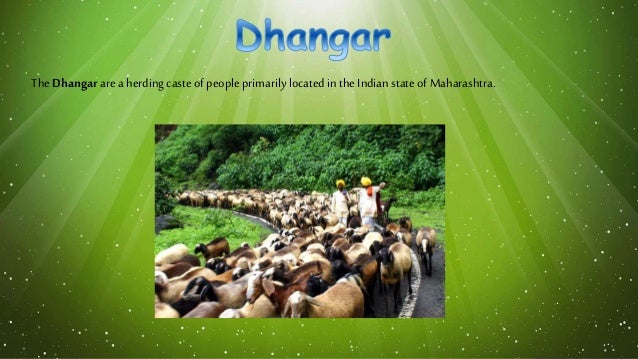
The Dhangar (Dhangad) are a herding caste of people primarily located in the Indian state of Maharashtra.

Etymology

The word "Dhangar" may be associated with a term for "cattle wealth" or be derived from the hills in which they lived (Sanskrit "dhang").[1] Ul Hassan noted that some people of his time believed the term to come from the Sanskrit "dhenugar" ("cattle herder") but dismissed that etymology as being "fictitious".
Current situation
Traditionally being shepherds, cowherds, buffalo keepers, blanket and wool weavers, butchers and farmers, the Dhangars were late to take up modern-day education. Though they have a notable population, not only in Maharashtra but also in India at large, and a rich history, today they are still a politically highly disorganised community and are socially, educationally, economically and politically backward. They lived a socially isolated life due to their occupation, wandering mainly in forests, hills and mountains. In Maharashtra, the Dhangars are classified as a Nomadic Tribe but in 2014 were seeking to be reclassified as a Scheduled Tribe in India's system of reservation.
The 2011 Census of India for Uttar Pradesh showed the Dhangar classified as a Scheduled Caste, with a population of 43,806.

Culture

Dhangars worship various forms of gods, including ShivaVishnuParvati and Mahalaxmi as their kuldevta or kuldevi. These forms include KhandobaBeeralingeswara (Biroba), Mhasoba, Dhuloba (Dhuleshwar), Vithoba, Siddhanath (Shidoba), Janai-Malai, TulaiYamaiPadubai, and Ambabai. They generally worship the temple of these gods that is nearest to their residence which becomes their kuladev and kuladevi. In Jejuri, the deity Khandoba is revered as the husband of Banai, in her incarnation as a Dhangar. He is, therefore, popular amongst the Dhangars, as they consider him their kuldevta. Khandoba (literally "father swordsman") is the guardian deity of the Deccan.
Image result for dhangar imagesImage result for images of dhangar community

Friday, 24 February 2017

Gaudas

Gaudas and Kunbis are aboriginal people residing in the coastal Indian state of Goa. They are believed to be the original inhabitants of Konkan. Most of them have been following folk Hinduism,whereas many were baptized to Catholicism by the Portuguese missionaries in last few centuries,while they have still kept their folk tradition and culture alive.They were hierarchically classified as landless laborers.


Current Social status

They are categorised as an Other Backward Class.

Modern organizations

Gaudas, Kunbis, Velip and another shepherd tribe called the Dhangar, have organised themselves into an aboriginal focussed network, called The Gauda, Kunbi, Velip and Dhangar Federation or in short GAKUVED. Another Adivasi-rights resource center MAND also works for their betterment.

Shuddhi movement

On 23 February 1928, many Catholic Gaudas were re-converted to Hinduism notwithstanding the opposition of the Church and the Portuguese government. This was carried out by a Hindu religious institution from Mumbai known as Masurashram. The converts were given Hindu names but the Portuguese government put impediments in their way to get legal sanction to their new Hindu names. 4851 Catholics from Tiswadi,2174 from Ponda,250 from Bicholim and 329 from Sattari Catholic Gaudas were re-converted to Hinduism after nearly 400 years. The total number of the converts to Hinduism was 7815.